
Bureaunia Chronicles: Episode 3
Staring at the Anti-Silo Consulting report and the $500M bank balance again, the Professor-turned-Governor-turned-Minister Auditax recognizes that success of a digital transformation project depends not only on addressing technological and governance challenges, but a whole range of dimensions. In addition, success depends not on imported answers, but on asking ruthless, fundamental questions—ones that cut through the noise to the heart of power, purpose, and people. And then finding answers from his own people, guided by international experts.
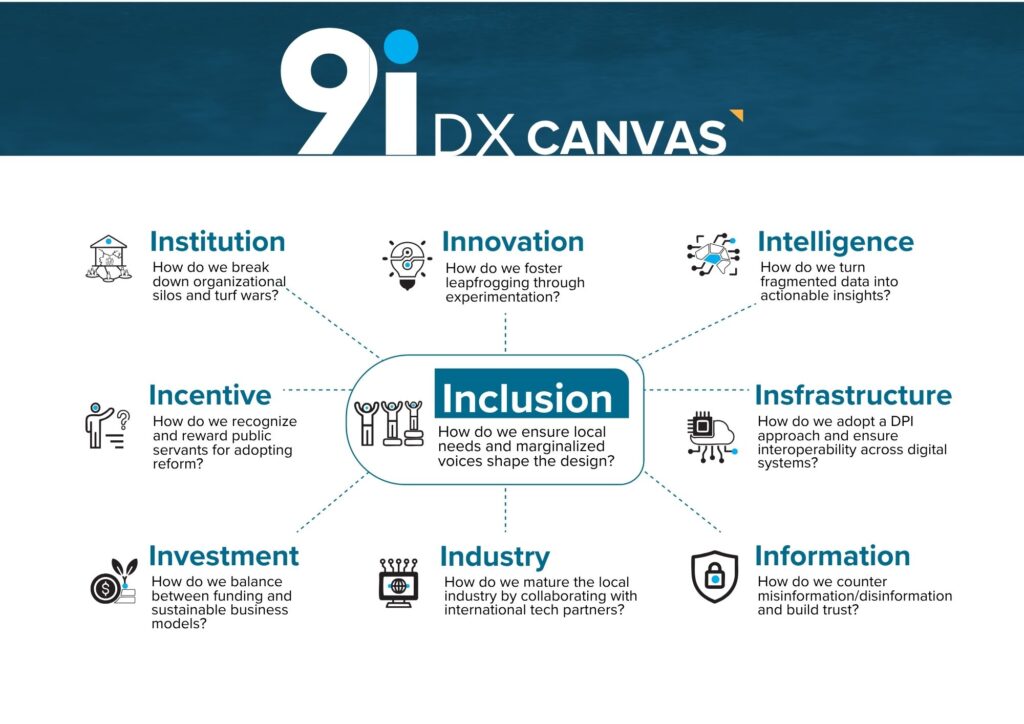
In the last episode of Bureaunia Chronicles, he was in search of answers on how to proceed with his colleagues. He searched across the globe over the entire summer of 2025 and found something quite interesting: The 9i Digital Transformation (DX) Canvas inspired by the 9 blocks of the Business Model Canvas and aligned with the principles and commitments of the Global Digital Compact (GDC) which emphasizes inclusive, rights-respecting, and sustainable digital transformation at the local, national and global levels.
The Canvas shows a bird’s eye view of the most vital dimensions to focus on in a nation’s digital transformation journey. It may prove to be a helpful instrument that a Minister, or a funder, or an advisor to the government may utilize not only to create a one-time action plan, but go back to it again and again for guidance based on changing circumstances, local and global, within the government and outside.
The 9i Digital Transformation (DX) Canvas
The nine dimensions (Inclusion, Institution, Incentives, Infrastructure, Intelligence, Industry, Investment, Information, Innovation) form the Digital Transformation (DX) Canvas. It’s not about ticking boxes, but about asking: are we transforming lives, or just modernizing dysfunction?
Are we truly saving people’s time, cost, and trust, or just digitizing old inefficiencies?
Inclusion: Design for the Last Person First
How do we make sure the most marginalized—women, the poor, elderly, persons with disabilities, Indigenous groups, and Cottage, Micro, Small and Medium Enterprises (CMSMEs) and micro-merchants are not left behind?
The technologists, technocrats and the analysts have traditionally designed for people like “us” whereas the people we are trying to serve by moving to digital don’t have the amenities, access and authority that we do. They are not only the last-mile, they are often the last-person. “Mobile-first” sounds progressive, but if a large number of people lack smartphones, affordable data, or the skills to use them, it is exclusion by design. Inclusion means starting from the back of the queue. Digital means multimodal access: an access centre within walking distance run by micro-entrepreneurs who help the poor village widow to apply for a government social safety net program; a call centre powered by local language voice-enabled AI where the widow can call in to file grievances because she didn’t get the entire amount she was supposed to receive the month before.
Bangladesh’s 9,500+ Digital Centres, run by local entrepreneurs (many women) ensure everyone has service access within 10km, with nearly 5k centers offering agent banking for the unbanked, including elderly villagers, CMSMEs, and those without smartphones.
Institution: Break Silos, Build Bridges
How do we redesign institutions to move beyond silos and turf wars, and answer the needs of the people they serve?
Too many governments digitize colonial-era processes, reinforcing inefficiency. Institutions must be re-engineered, not just automated. That means simplifying delivery processes, breaking silos before digitizing the processes, and creating bridges, human coalitions, rules, and partnerships that serve people instead of pushing paper. Sometimes, breaking institutional silos is difficult because of turf controls that preserve the status quo which benefit existing institutions and the powers that be. Interestingly, digital allows bridge-building in a digital form while preserving the physical silos, a useful compromise in the interim. Then, over time, ample opportunities will evolve to reform and rebuild institutions.
In Rwanda, the IremboGov platform single-window portal provides people and businesses access to over 100 government services online such as birth certificates, driver’s licenses, and business registration while their underlying physical silos remain. It simplifies a previously complex, paper-based system by offering a unified front for services, reducing bureaucracy, and improving efficiency.
Incentives: Reward Reformers
How do we change the status quo for public servants so that reform is rewarded, not resisted?
Civil servants are trained to move files, not to move mountains. Why take risks when safety is rewarded? This risk-averse, safety-first culture is probably one the most important barriers to digital transformation of public service delivery. At the same time, there are change champions who are waiting for the right opportunity to work in the interest of the last-mile and the last-person. It is critical to identify them and create an autonomous space for experimentation where they can attempt quick wins without fear of career setbacks, and removing barriers for such innovations. In addition, they can be further aided by providing an “innovation grant” with creative financing, catalyzing meaningful partnerships with the higher-ups within the government and providers in the industry, and, very importantly, by recognizing the small and large reform efforts by individuals and small groups within the civil service. Because, they indeed shape the impetus for sustained and large reforms over time.
Singapore’s public servant incentives for digital transformation are a comprehensive system that combines financial rewards, capability development, and a culture of innovation. The renowned PS21 initiative recognized over 100 projects in 2024 and has generated significant cost savings through grassroots programs.
Infrastructure: Connect the Islands
How do we ensure today’s digital “islands” evolve into interoperable, whole-of-government systems?
A tax portal here, a health app there, an education database somewhere else—none talking to each other. This is not transformation; it is fragmentation. Foundational Digital Public Infrastructure, ID, payments, data must connect these islands into bridges that people can actually walk across. It is important for policymakers and funders to understand that the most impactful aspect of digitalization is that it allows sharing of data seamlessly without breaking physical boundaries. Let physical walls exist for as long as they must because some forces preserving and maintaining these walls are too strong to dislodge. Use the principles and approach of DPI, ensuring the DPI Safeguards from the UN and UNDP are adhered to in order to establish interoperability across digital systems before long-term institutional reform can be effected.
India’s combination of Aadhaar ID system and Unified Payments Interface (UPI) shows this in practice: linking through DPI 1.3 billion people to banking, mobile, and welfare services, and facilitating 20 billion frictionless payments per month (Aug 2025 data), it has become the backbone of seamless, interoperable service delivery and payments at national scale.
Intelligence: From Data to Insights
How do we connect fragmented data into actionable insights that guide better decisions?
When data is locked in silos, decisions are little more than guesses. Federated, secure, real-time data flows allow governments to see the whole picture. COVID-19 proved that sharing data across organizations transcending public and private boundaries saves lives. However, somehow our goldfish memory has not allowed us to remember the lessons COVID-19 taught us, and we went back to our respective cocoons. We know we can do better and we know how to do it. In addition, the last few years have taught us something new: how AI can help us create new insights and make quicker decisions. Is it this nexus of human and AI working together to shape “collective intelligence” platforms that will advance the human experience further.
Togo’s Novissi platform showed the way, linking voter ID, mobile money, and satellite data to deliver emergency cash to informal workers within days. The future lies in human and AI collaboration, shaping collective intelligence to act before crises, not after.
Industry: Grow Local Talent Aggressively through Global Partnerships
How do we enable local tech ecosystems to grow while aligning with national development goals?
Dependency on foreign vendors leaves nations vulnerable. Conversely, isolation breeds and sustains weakness. Local ecosystems must be strengthened, learning by doing, building capacity, and gradually owning the platforms. Digital transformation succeeds when local innovators shape the future instead of importing it. However, nations cannot wait for the local innovators to mature and must embrace partnerships that bring in proven talent and experience while keeping a strong eye on nurturing local talent aggressively. Interestingly, AI can help in this strategy by opening up options to understand customers needs, technical design and development, operations and maintenance of digital systems. Developing nations—the policy makers and the industry leaders alike—must believe that AI will not replace human beings in the IT industry but will replace human beings who don’t know how to use AI to improve personal, group and organizational productivity.
Estonia’s tech ecosystem includes over 1500 startups, and. approximately 80,000 e-residents worldwide use Estonia’s digital services, contributing to a highly connected and globally integrated ecosystem while maintaining domestic ownership.
Investment: Beyond Donor Cycles
How do we move beyond donor dependency toward financing that balances quick wins with long-term sustainability?
Too many projects die the moment funding ends. That is not transformation, it is a digital graveyard. There was a time when a particular African country allowed the blooming of a thousand flowers in the healthtech space. A map of that country with all the dots representing the pilots made the country look like it was infected with “pilotitis”. The real measure of success is not what launches, but what survives. Beyond the traditional grants and loans, which are of course necessary, resource-strapped countries must look to blended finance, cross-subsidies, and public–private partnerships that will ensure systems outlast donor cycles. In many cases, even though the initial development of digital systems may be financed by donor investments, it is possible to develop business models where the operational costs and future evolution of these systems can be supported by charging service seekers small transaction fees that they find negligible, and hence, affordable.
Kenya’s M-Pesa mobile money system began as a UK’s DFID-backed pilot with Vodafone and Safaricom but quickly became a self-sustaining model, using small transaction fees to fund growth and proving resilient beyond donors, politics, and shocks, proving that digital services can become financially self-sustaining.
Information: Rebuild Public Trust
How do we fight disinformation and rebuild trust between people and their governments?
If people don’t trust the system, adoption fails—no matter how advanced the technology. Fighting disinformation requires transparency, radical honesty, and accountability. Trust is not a side effect of digital government; it is its foundation. Unfortunately, misinformation that unintentionally hurts and disinformation that deliberately harms are on a dramatic rise. What is worse is that AI only makes this more pronounced. The “Countering disinformation for the promotion and protection of human rights and fundamental freedoms” released by the UN at the UNGA in September 2022 outlines multifaceted and multiparty recommendations ranging from legal frameworks to regulatory interventions to media and digital literacy to education reform, and very importantly, the roles and responsibilities of the media, government, tech companies especially the bigtechs, NGOs, communities and common people.
Innovation: Leapfrog, We Must
How do we unleash leapfrog solutions?
Every country has a graveyard of pilots—pilotitis—that went nowhere. Despite that, today’s world is a true illustration of the cognizance in Alice in Wonderland: “My dear, here we must run as fast as we can, just to stay in place. And if you wish to go anywhere you must run twice as fast as that.” Traditional development approaches will ensure a trajectory where the nation will continue to fall behind, and its people continue to suffer more and more. Since the whole point of digital is to leapfrog, innovations must not only be encouraged across society, but the state and non-state actors including the private sector, tech companies and academia must come together with a vision to leapfrog. And this innovation culture and ecosystem must be inspired and financially supported through political will at the highest level, regardless of which political party forms the government and whatever regime change takes place.
Brazil’s Gov.br represents scaled digital transformation with 156 million users accessing 4,000+ services, reaching 80% of the adult population through frugal design that works within existing infrastructure constraints, while sustaining growth across different political administrations since its launch, making it irreversibly embedded in Brazilian governance.

Way Forward in Bureaunia
The Bureaunian Minister Auditax, is attending the UNGA in New York City in September 2025. If you are a policymaker, a funder, or an advisor addressing challenges similar to Bureaunia’s, talk to Auditax and find out the approach he is taking with the 9i DX Canvas. Explore how the Canvas can help you build the initial action plan for digital transformation of your entire country or a specific sector, or revise and update new versions of an existing plan towards greater inclusion, interoperability and institutional sustainability.
Leave a Reply