Bureaunia Chronicles: Episode 6
“If Your Grandmother Can’t Use It, It’s Not DPI.”
I’m Mariamix. I’m the grandmother your system is supposed to work for.
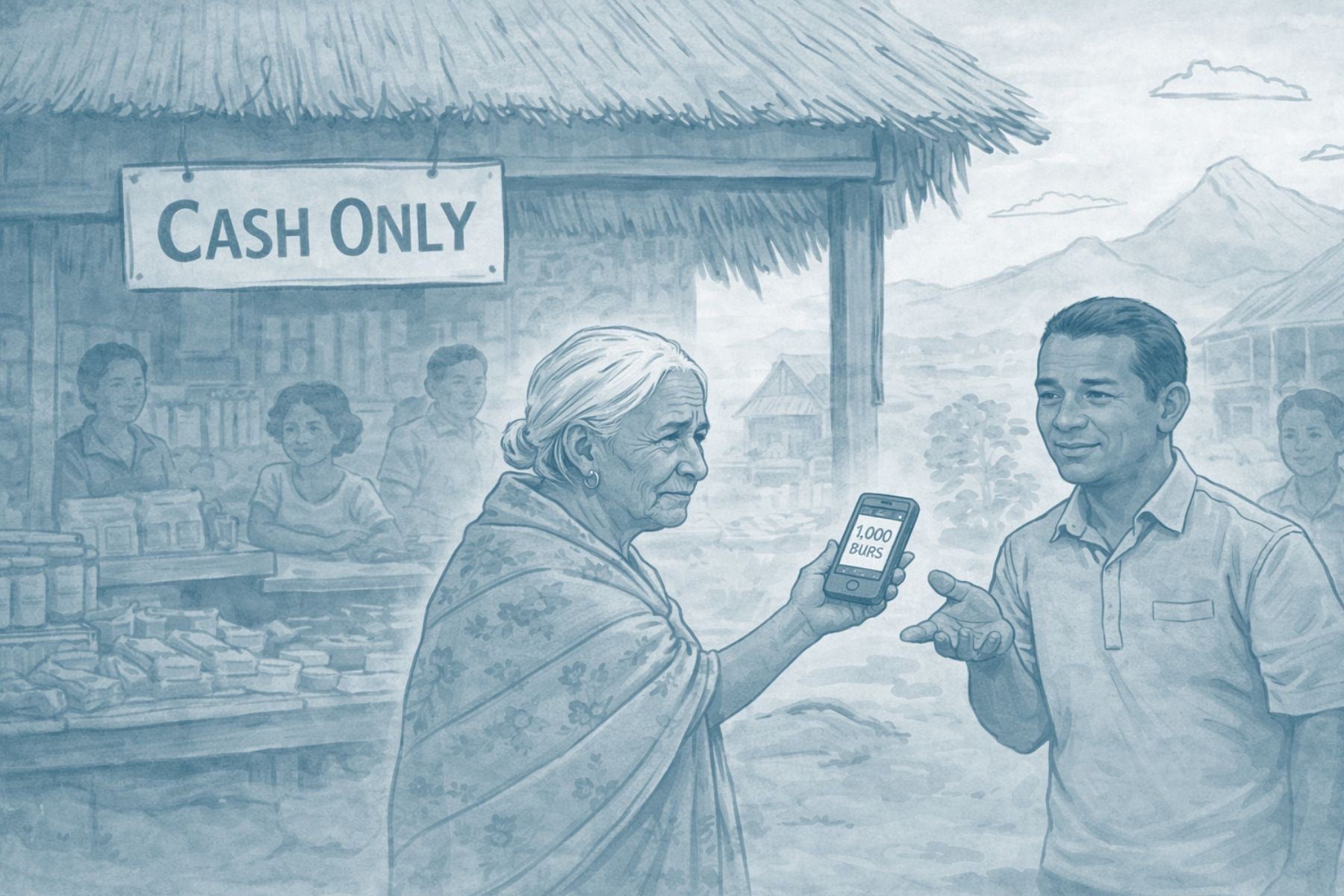
I did everything right. I proved I’m alive on a video call. The government credited my old-age allowance, 1,000 Burs, into my BurePay wallet. Somewhere in the capital, that counts as progress.
Then, I walked to the corner shop and heard the two words: “Cash only.”
In the afternoon I needed to meet my daughter in the next village. I reached for my phone to pay the bus fare but the conductor laughed. “We don’t take BurePay,” he said. “Cash.”
So my allowance was there on the screen and still useless in the moments that mattered most.
My life isn’t one big monthly purchase, or a series of payments to fancy stores which take credit cards.
My life is about 50 small transactions a month, groceries every couple days (no fridge), phone top-ups and bus fares a few times a week, then medicine, toiletries, and electricity once a month. Fifty moments where money has to work now, with a real person across the counter.
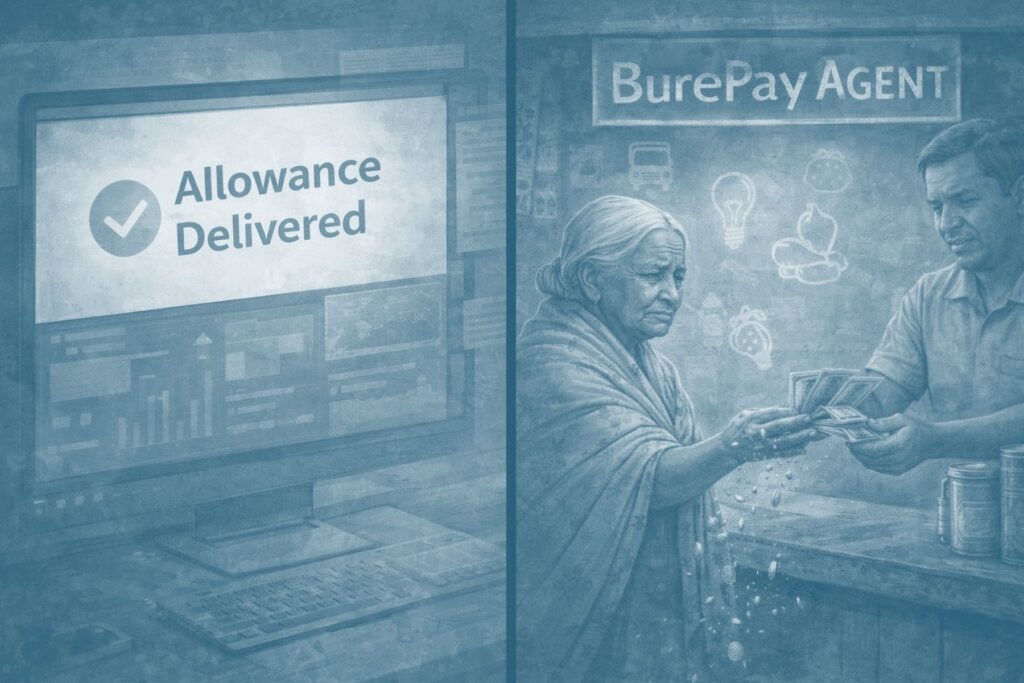
So, I cash out my entire allowance. But cashing out is a tax for being poor.
I’m promised 100% of my benefit, yet the last mile quietly takes a bite.
When “Delivered” Isn’t “Received” for Mariamix
In the capital, Finance Minister Auditax says: “If your grandmother can’t use it, it’s not DPI.” He tells the room: “Our success isn’t money landing in a wallet. Our KPI is whether Mariamix can pay at the shop, the pharmacy, and the meter without cashing out her dignity.”
Then the team maps her actual needs, not the ministry’s dashboard numbers, but her fifty-transaction-a-month life:
- Pay groceries + medicine to small merchants (Person-to-Merchant / P2M)
- Pay utilities + transport to government or private sector large companies (Person-to-Government & Person-to-Business/P2G, P2B)
For all these payments, her payment must be instant to the receivers. No “pending.” No “come back tomorrow.”
If she pays cash, it’s instant but she loses money. If she has to pay through QR code, she needs a smartphone which she doesn’t have. In addition, most of the informal MSME vendors are not digitally enabled.
This is not a problem unique to Bureaunia. Other countries have already solved this problem by designing payments around how the marginalized actually live.
Auditax’s team studied two countries that solved these real problems:
Lesson from Country 1: Launched in March 2022 for India’s approximately 400 million feature phone users, the UPI 123PAY enables digital payments without smartphones or internet through IVR calls where users dial a number and follow voice prompts, missed calls where the system calls back to complete transactions, app-based payments on select feature phones. Users enter merchant IDs/amounts/PINs via keypad for P2P/P2M payments. Even no internet needed. No smartphone. No data. No borrowing someone else’s phone. Just her feature phone and a simple code.
Lesson from Country 2: Tanzania (TIPS) processed 450+ million interoperable transactions worth nearly USD 12 billion by 2024, connecting 46+ banks and mobile money providers like M-Pesa and Tigo Pesa, so money can move in real time between people, businesses, government, and financial institutions.. Feature-phone users can pay via USSD (for example dialing *150*01#) for bus fares and government payments, with settlement happening in seconds. No smartphone, no internet, no need to cash out.
Auditax’s solution for Mariamix
Auditax’s team redesigns BurePay with both country lessons: feature-phone Voice IVR and USSD payments for utilities and transports..
Mariamix’s problem isn’t receiving her allowance, it’s being forced to cash out because shops say “cash only” for two reasons:
- digital payments are not truly real time and
- payment receivers don’t have the incentives to adopt it
Auditax’s fix is to make BurePay instant and verifiable so merchants adopt it and Mariamix can pay digitally for groceries, medicine, utilities, and transport leaving cash-out to the exception.
Auditax calls Governor Regulix to his office and asks for the missing piece: “We can improve BurePay, but merchants won’t accept ‘instant’ if settlement arrives tomorrow. We need pipes that flow in real time everywhere shop, bus, pharmacy, so ‘paid’ means received.” Regulix nods, then points to the next bottleneck, the counter. The next episode is about why Paulix, the corner shopowner, keeps a sign that says “Cash only”.
Anir Chowdhury
#DigitalEquity #DigitalTransformation #DigitalInclusion #BureauniaChronicles #DXA #9iDXCanvas #FinancialInclusion #DigitalPayments #InstantPayment #DigitalForAll #InclusiveFinance #MoneyThatWorks
Leave a Reply