
Bureaunia Chronicles: Episode 9
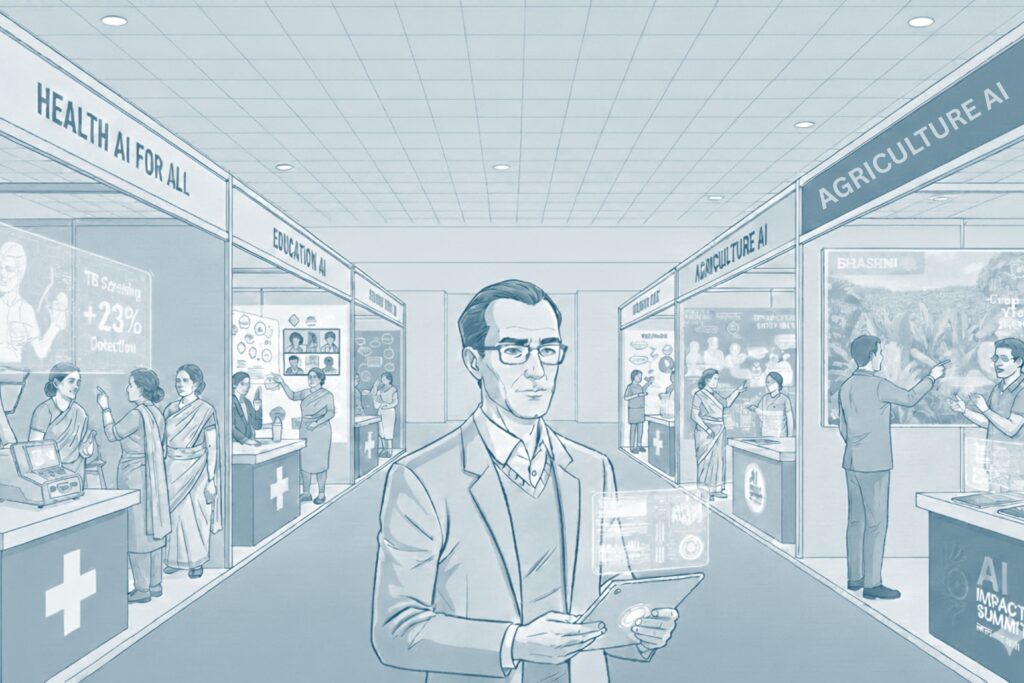
700 sessions in the very important and timely AI Impact Summit 2026 in New Delhi, the first such massive event in the global South, with global tech luminaries extolling the virtues of AI to leapfrog development.
However, Aithorix, Chief AI Advisor of Bureaunia presenting his country’s AI strategy, has a nagging feeling that the reality is somewhere in between the all-rosy and the all-doom. Where does one find the balance?
When AI Actually Equalizes
The summit isn’t wrong to be hopeful. Evidence exists. Not in whitepapers, not as “AI pilots” but scaled impact on the ground.
Saving lives: AI has already done what weak systems often cannot. Bangladesh used self-reporting through IVR and syndromic surveillance during COVID for months before RT-PCR labs were deployed, tracking 1.5 million cases, enabling targeted lockdowns. Tunisia tracks pathogens across 21 wastewater plants, detecting polio resurgence before clinical cases emerged. South Africa’s air quality network uses affordable sensors, reducing respiratory hospitalizations 18% in monitored areas. Wadhwani AI deploys TB screening across Indian states, detecting 23% more cases than human review alone, reducing diagnosis time from weeks to hours. In Guatemala, AI portable ultrasounds use local-trained models for fetal biometry and anomaly detection among Indigenous women, achieving 85%+ accuracy to enhance prenatal access. From Brazil to Bangladesh, South Africa to Indonesia, Lebanon to Ethiopia, and many countries in between, these innovations are improving health outcomes, redressing health inequities, and strengthening health systems.
Restoring livelihoods: Kenya’s Farmer.Chat reaches 14,000 farmers across Kenya, Ethiopia, India, Nigeria, 40% crop yield increases. Apurva.ai weaves community voices with institutional knowledge from the Ministry of Agriculture and SELCO Foundation, transforming fragmented data into actionable insights, reaching 50,000 farmers with climate-adaptive advisories. AI-driven credit scoring in LDCs like Kenya, Uganda and Egypt has boosted loan approvals by 20-60% for unbanked individuals, using mobile data and driving financial inclusion for millions excluded by traditional banking.
Spoken languages the ultimate access to digital: Nine years ago, Google’s CEO Sundar Pichai pledged AI would make information “universally accessible” regardless of language. India’s Bhashini—36 languages, 350+ AI models, 500+ government websites, enables millions to access services in their mother tongue, processing 2.1 million translation requests daily. Gates Foundation’s African Next Voices—$2.2M, 9,000 hours across 18 African languages, largest AI-ready language initiative for Africa. Millions can now speak to systems that once had no ear for them.
Infrastructure made intelligent: Organizations like CDPI advise nations on interoperable systems. Co-Develop mobilizes resources for safe DPI adoption across 50 countries. DPI establishes the foundation, digital identity, payment systems, data exchange,as publicly governed, interoperable infrastructure. AI-enabled DPI transforms this into responsive intelligence: analyzing patterns across systems to predict where exclusion will occur, optimize benefit distribution in real-time, and adapt delivery mechanisms before gaps become crises.
Turbo-charging development planning: Bureaunia is in the process of redesigning its government-to-person (G2P) system using DXA, a GenAI-powered planning tool, as the Ministry of Social Welfare evaluates reforms before implementation. DXA analyzes local institutional realities, fiscal constraints, and service gaps while drawing on global best practices to simulate ‘what-if’ scenarios and design an inclusion-first, interoperable, and context-aware delivery architecture that protects Bureaunia’s most vulnerable communities first.
When AI Divides
Killing jobs: IMF warns AI will affect nearly 40% of all jobs worldwide and 60% in advanced economies. Unlike previous industrial revolutions, this one targets knowledge workers first. Anthropic’s CEO warns AI could eliminate half of all entry-level white-collar jobs within one to four years. In 2025’s first six months, 77,999 tech job losses were directly attributed to AI.
Widening North-South divide: Promise alone doesn’t bridge divides. In fact, it can widen them. AI adoption in the Global North is roughly twice that of the Global South, with the gulf widening sharply where GDP per capita falls below $20,000. High-income countries hold 87% of notable AI models, 86% of AI startups, and 91% of venture capital funding, yet represent just 17% of the global population. The barrier right now isn’t just access but skills, technical capacity, and institutional readiness.
End of the road for languages and cultures with insufficient digital footprint: GenAI runs on language data. Estonia, among Europe’s most digitally advanced (5.2% enterprise AI adoption), also faces a crisis: Insufficient Estonian-language data means LLMs can’t learn their culture, an issue we saw earlier when talking of African languages. It is existing languages that face extinction in AI’s training corpus. If the language lacks data, it’s easy to become invisible.
Creating “Lazy Thinkers”: Research shows strong negative correlation (r = −0.68) between AI tool usage and critical thinking. AI encourages offloading cognition, reducing engagement. Learning needs effort, struggle. Without struggle, capacity deteriorates. Most visible in classrooms: AI transforms learning without evidence of deeper understanding. “Technology must remain a tool, not become the teacher.”
Destroying lives: Netherlands’ welfare scandal: thousands wrongly accused of fraud. Immigrants 22 times more likely investigated than native Dutch. Dual citizenship flagged as fraud. Government resigned. Rotterdam ran a similar system targeting single mothers and non-Dutch speakers. Who protects the wrongly accused or the millions next?
Weaponizing distrust: 57% distrust social media globally. 64% fear mobile falsehoods. 40% lose media trust, 22% government trust due to disinformation. Summit conversations with The World Bank, UNDP, Global Solutions Initiative, Project Liberty, Haqdarshak, FAR.AI reinforce a hard truth: AI-amplified harms advance faster than trust, safety, regulatory capacity of global majority countries. Deepfakes, cyber threats, AI-driven disinformation aren’t edge cases, they’re operational risks. When AI embeds into public systems without safeguards, failures become economic instability.
Shooting yourself in the foot: Elon Musk’s Memphis data center demands 150 MW, enough to power 100,000 homes. His vision: 1 gigawatt capacity, more than twice Pittsburgh’s residential consumption. A typical hyperscale data center draws as much electricity as 100,000 households. Some new facilities consume more electricity than entire cities. India’s Rajasthan, where temperatures hit 50.8°C pushes to attract $2.4 billion in data centers. Mexico’s Querétaro, in its worst drought in a century, faces 32 planned data centers threatening families’ drinking water. Chile’s Santiago: proposed Google data center consuming 7.6 million liters daily, entire community’s annual usage.
Questions a Searcher Carries
Globally, 2.2 billion people are still offline. 730 million lack access to electricity, eight in ten of them in sub-Saharan Africa. 800 million have no official proof of identity; close to 3 billion lack access to digital ID systems. These aren’t background statistics.
Bureaunia, with 120 million people and a $950 per capita income, has insurmountable challenges and the numbers don’t look great.
Only:
- 60% can read.
- 15% can navigate digital systems.
- Fewer than 1% understand AI.
- Youth unemployment stands at 34%. That’s over 40 million of the youth
Of 72 million with mobile access, barely 660,000 use digital services meaningfully.
Aithorix walks through the halls carrying more than optimism. He carries questions, confusions, and apprehensions. Barely anybody in Bureaunia understands AI. So who will audit the bias, question the hallucinations, and protect the vulnerable? How will a nation with 40 million unemployed youth prevent AI-driven automation from deepening joblessness when many are already surrendering their critical thinking abilities to AI tools?
Takeaways from the Summit
In the return trip back home, Aithorix jots down action items for his partners as his briefing presentation to the country’s President.
For policymakers:
DPI as the plumbing, and AI as the intelligence for human agency and decision making. Mandate audits, redress mechanisms, and procurement standards that measure inclusion, not just efficiency. Invest in AI usage, not just literacy, inside government, not only in startups. Make AI governance institutional, not personal, so audits, safeguards, and accountability survive transfers and leadership changes.
For technologists:
Treat hallucinations, bias, and language gaps as deployment blockers, not “later fixes.” Build with communities, not around them. Design for low-connectivity, low-literacy realities: voice, offline, assisted, phygital. Treat “AI skills gap” and “trust gap” as core product requirements.
For funders:
Stop financing only the “build.” Finance the infrastructure of trust: language datasets, audit capacity, safety testing, public-sector institutional capacity, long-term operations. Support business models that maintain public-interest AI, turn innovation into real outcomes, and sustain beyond donor financing. Don’t fall into AI pilotitis.
For UN bodies and global partners:
Shift from declarations to enforceable support: shared evaluation frameworks, public-interest DPI and AI audits, strengthening of local institutions and industry. The UN’s Global Digital Compact’s promise must translate into resilience where the risks hit first. Support countries not only to adopt AI, but to govern it at the pace AI is moving.
Aithorix will look for partners with the empathy to recognize that equalizing Bureaunia means building with communities, not for them, especially women, rural youth, informal workers, persons with disabilities, elderly citizens, and small local entrepreneurs who are too often the last to benefit and the first to be excluded.

The choice isn’t AI or no AI. It’s recognizing the need to formulate and adapt solutions to the realities faced by Bureaunia and the global South and having the courage to call out practices of the global North as not always being the superior option. The choice is to find the best solution to help equalize, not divide.
Anir Chowdhury
#BureauniaChronicles #DXA #DPI #9iDXCanvas #DigitalPublicInfrastructure #DigitalDevelopment #TechForGood #AIGovernance #GlobalSouth #Inclusion #PublicPolicy #AIEqualizer #AIDivides #IndiaAIImpactSummit #IndiaAI #AIImpactSummit2026
Leave a Reply