Learn from the last country, Serve the last person in your country
Traditionally, digital innovation was a one-way street where knowledge flowed from the Global North to the South. However, 2025 marked a historic reversal of this 20th-century paradigm.
The legacy model of the Global South adopting rigid Western banking software has been replaced by a new reality: high-income nations are now looking Southward to adopt “Lego-block” digital architectures. These systems, pioneered in developing economies, prioritize interoperability and open-source foundations over proprietary silos. G7 nations have specifically begun integrating the “QR-first” merchant strategies and “Open Finance” regulatory frameworks found in the Global South, granting consumers a level of data portability and agency that was previously more advanced in developing nations than in the West.
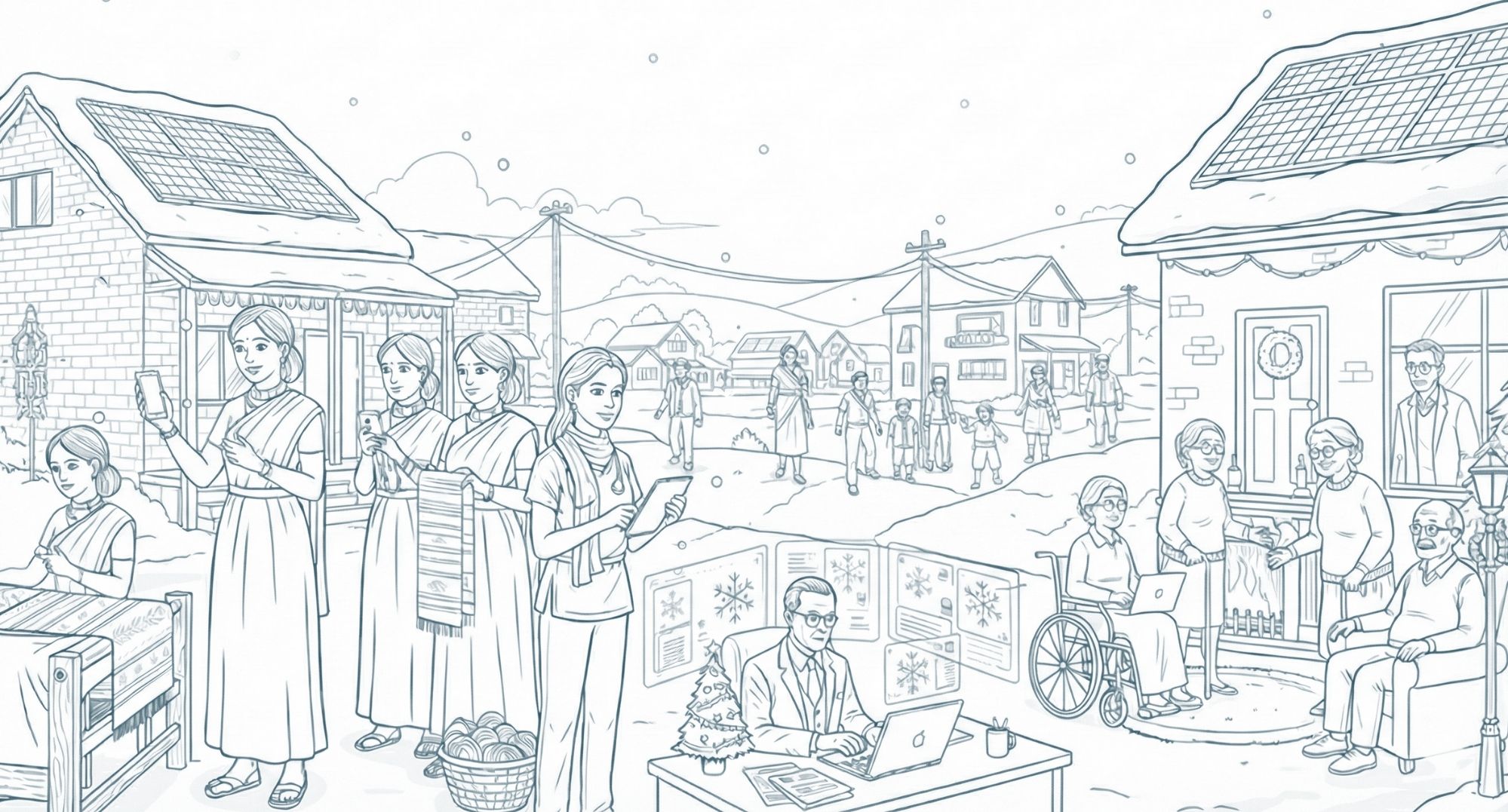
Furthermore, the Global North is re-evaluating its assumption that universal smartphone ownership is the only path to meaningful connectivity. By adopting the Global South’s model of “assisted centers” which utilize human-mediated digital access, developed countries are finally addressing the persistent gaps in their own digital inclusion efforts, acknowledging that human support is often the missing link in a truly inclusive digital society.
This trend reversal is giving Bureania hope. Its policymakers are starting to believe that if you want to reach the last person, learn from the “last country.”
Not because that country is behind, but because it often invents the smartest solutions under the most difficult constraints: frugal, resilient, human, and scalable.
This hope reverberated across the Global AI Summit on Africa in Kigali in April, UNGA in New York City in September, World Bank’s Annual Meetings in Washington DC in October, and the DPI Summit in Cape Town in November.
Cross-sector “builders” have shown what coordinated inclusion can achieve: the World Economic Forum’s EDISON Alliance reports over 1 billion lives connected to essential digital services, ahead of the original 2025 target.
2025 started the celebration of DPI as the foundation for inclusive, safe and frugal digital transformation for resource-constrained developing countries. DPI gurus, governments, funders, think tanks are learning together, not as “donors and recipients,” but as peers building shared public foundations. At the Global DPI Summit, leaders and practitioners from 100+ countries came to share and learn from what’s working, what’s repeatable, and what’s safe to scale. The 50-in-5 campaign has reached 30 countries (on the path to 50 by 2028), making “reuse” an action rather than a slogan.
The good news: between 2021 and 2024, about 400 million new digital IDs were added globally facilitating online transactions. The bad news: 2.9 billion people are still excluded.
The fact: most of the new people who were included with digital IDs are in sub-saharan Africa. The realization: innovation trumps resources.
Bureaunia has 120 million people, but only 55% have a digital ID. We want to be part of the good news with universal digital ID coverage by 2030.
Learning from countries who have made the biggest progress with the least will allow us to leapfrog to serve the last person in our country.
Anir Chowdhury
#DigitalTransformation #DigitalPublicInfrastructure #DigitalInclusion#InstitutionalInnovation #BureauniaChronicles #DXA #9iDXCanvas #Inclusion #DigitalID #DigitalEquity #ServiceSimplification #GlobalSouth #DigitalID #ServeTheLastPerson
Leave a Reply