Bureaunia Chronicles: Episode 2
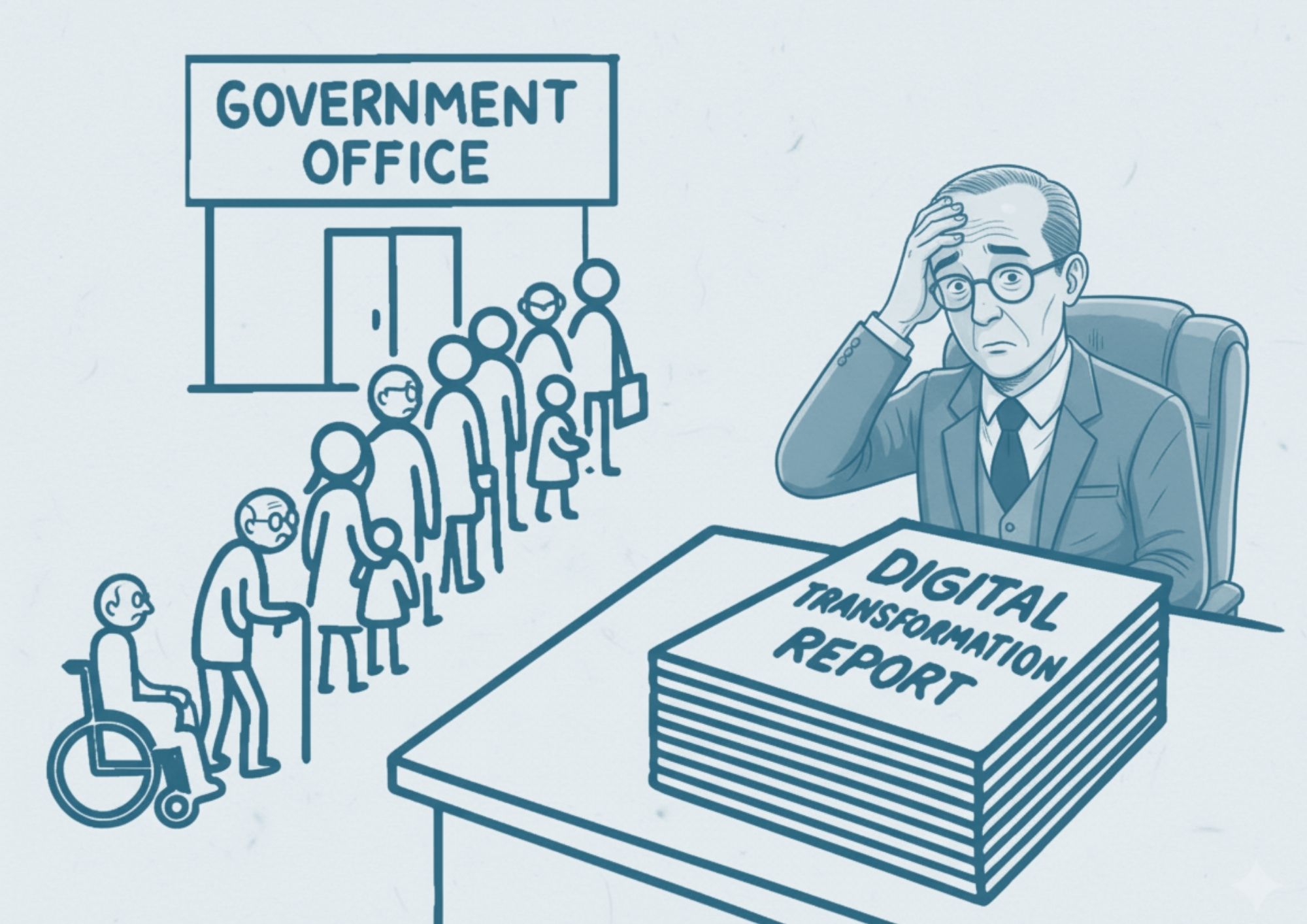
We have half a billion dollars, ambitious plans, and 120 million people counting on me. We also have the 500+ page report beautifully and painstakingly crafted by Anti-Silo Consulting sitting on my desk.
I recall seeing a similar report from a similarly reputed global consulting company a decade ago at the inception of our nationwide digital transformation journey. Different political parties formed the government in the last decade. However, the digital transformation of public services was one message where parties did not differ in their rhetoric. Indeed, the consistent promise of the politicians, bureaucrats, technologists, and funders all along has been to bring greater inclusion and equity.
But what happened in reality? I have fragmented systems. Designed as digital fortresses and not foundations. Not serving my people as intended. Sometimes even widening the divide between the haves and the have-nots.
Where did things go wrong? How did we pave a road to hell with good intentions?
I am a newcomer in politics. I taught economics at the Bureaunia National University for over two decades. I was quite a popular professor, if I may say so, and I enjoyed sparring with my bright, curious and optimistic students about how to make our impoverished motherland leapfrog from poverty and break free from the shackles of bureaucracy. We all hated the red tapes, the inefficiency, the power play, the corruption, and yet felt powerless against the powers that be.
Lightening struck about a decade ago, and I was selected by the then Prime Minister to serve as the Governor of Bureaunia Central Bank. Even though I knew I’d have to leave my comfortable, independent, intellectually satisfying role in academia for a high-stakes, stressful position within the bureaucracy, I decided to take the gamble. For decades, I had complained. Now I was given the opportunity to do something about the complaints. Perhaps even fix some of the problems I was so vocal about. Or, at least die trying!
Within the first week in the job, I realized how difficult it was to change things. How anti-people the rules were. But yet, how embedded they were within institutions for they had survived for decades, if not for over a century. Because of their colonial roots when the name of the game was command and control. Times have changed. People’s expectations have changed. Primarily driven by the agility, responsiveness and customer-centricity of the private sector which has to compete with each other. Whereas the government departments have remained monopolies with no incentive to reform the rules. In fact, I recognized the reality that not only was there no incentive, but every disincentive, to break the status quo.
I also discovered that all my central bank colleagues were slaves to the archaic, anti-people rules. Even some of my most optimistic former students who were now central bankers had become jaded over the years, and ceded control to these rules. Who wants to jeopardize their careers and put their necks on the line? There was guaranteed reprimand and penalty, and a very low chance of success.
Heroism in bureaucracy doesn’t pay. Even when there is early success, it doesn’t mean the change will be institutionalized or survive a shift in leadership.
Unless some reform-minded leader is relentless, courageous, and entrepreneurial enough to take on the challenge of:
- first understanding what difficulties common people face in accessing public services from the different departments of the government;
- developing a strategy, prioritized by people’s difficulties (pain points), feasibility of change (lowest hanging fruits), and possibility of public credit taking (demonstration effect);
- forming a guiding coalition of the influential and powerful people within and outside of the department, including “holy” alliances with the private sector;
- nurturing an internal team to keep chipping away at the fragmentation, inefficiency and, not to leave out the elephant in the room, corruption; and
- finally and most importantly perhaps, establish instruments of institutionalization—policy change, rules reordering, legal reform, and what have you—to ensure the change is not changed by new leadership when the reform-minded leader is gone.
I gave myself the role of the reform-minded leader, at least within the central bank, where I had authority, or so I thought. In my infinite naivete, I did not recognize that a professor on an extended leave of absence was still a philosopher with little practical experience of how to do all of the above against a strong and mounting tide. But that’s a story for a different day.
For now, as the new Finance Minister of the government of Bureaunia, I lay awake, stealing glances at the tome of a report from Anti-Silo Consulting on my desk.
Share your perspective as the next episode of Bureaunia Chronicles brings you 7 dimensions of impactful and sustainable digital transformation.
Bureaunia is imaginary, but the challenges are real for any developing nation.
Leave a Reply