Part 3: The Myth of Small AI
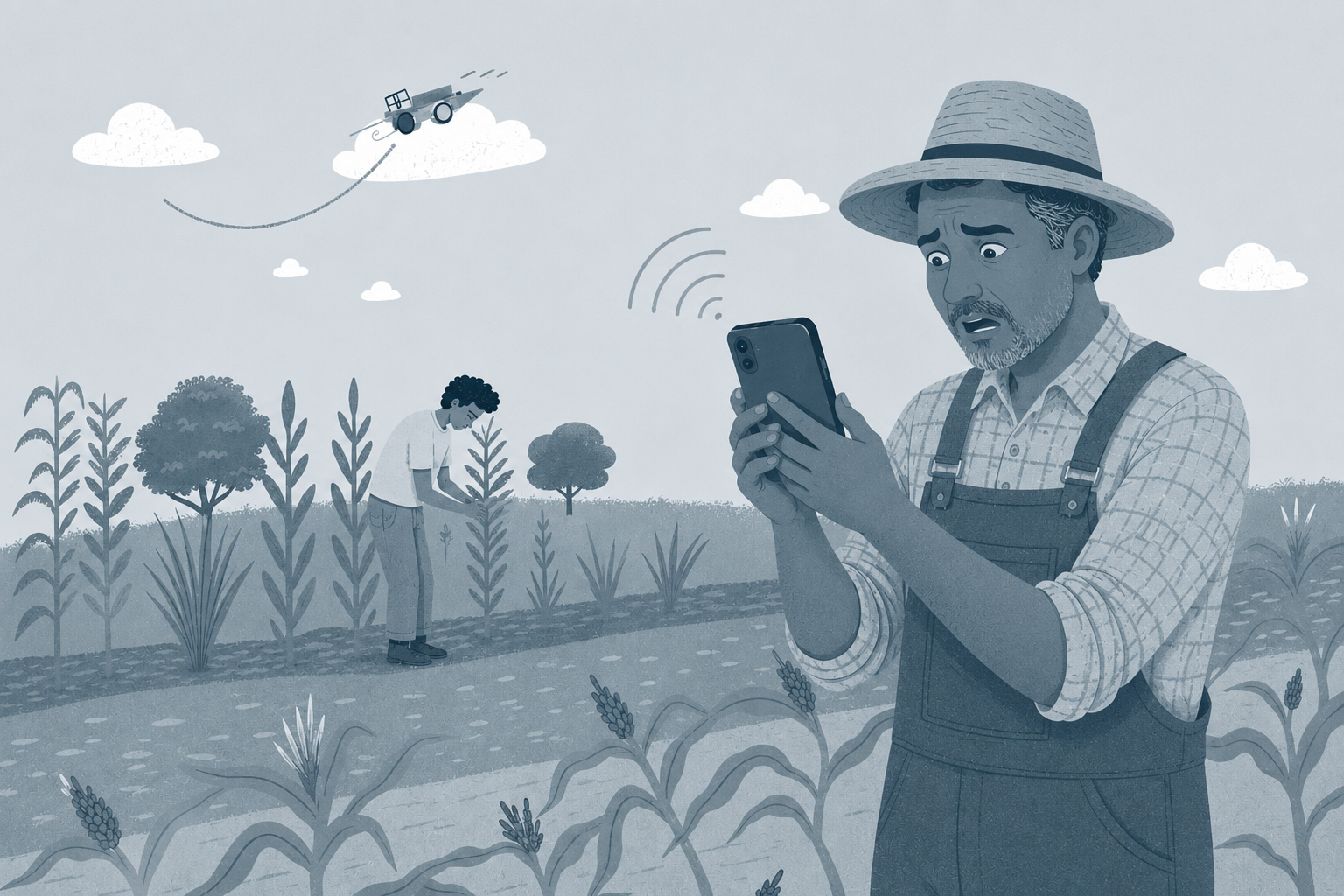
One morning, Joseph Mwangi almost had a heart attack. His crops were dying. He pulled out his phone and opened CropDoktor, an AI platform built just for farmers to detect plant diseases, and typed his question in his native language.
The app responded with instructions and Joseph quickly followed. A week later, his crops were dead. Joseph did not know that CropDoktor hadn’t been updated in over a year since its funding stopped and as a result, provided outdated answers.
Small may well be the answer to last mile delivery, but is it sustainable?
In Part 2, I explore how Small AI may be an answer to local problems, especially in resource-strapped situations of LDCs and LMICs and underserved areas of developed nations. Big AI is funded by tech giants, with hundreds of billions poured into infrastructure and “compute”.
The outcome is a powerful technology that is structurally designed to further serve those who are already served: expensive to access, blind to local context and silent in most of the world’s languages.
Small AI offers a different proposition: task-specific, locally trained, offline-capable, and deployable on a $20 phone.
Yet, there remains a number of questions regarding Small AI’s sustainability and ability to function commercially in comparison with Big AI: do Small AI innovators have the necessary infrastructure, human capacity and training data to build, sustain and operate Small AI solutions and ensure the output is impactful?
Small AI’s constraints:
Who builds small AI?
There is a scarcity of technical talent in global South countries, owing to a lack of investment in developing technical human capacity.
Building and sustaining a Small AI model requires machine learning engineers, data scientists, linguists, and domain experts who understand both the technology and the local context it serves. In most LDCs and LMICs, this talent pool is thin.
This is aggravated by a massive brain drain of qualified talents who migrate to global north countries in search of better opportunities. A Kenyan engineer who can train a crop disease model is far more likely to end up working for a Silicon Valley company than building tools for smallholder farmers in the Rift Valley.
Who trains small AI?
For Big AI, generating training data is not as tedious as that of small AI.
Large investments fund data collection and free versions accessible on larger platforms such as ChatGPT, Gemini, Claude, etc. help generate massive amounts of training data from prompts and questions entered by free users. As a result, while still generalized, they easily access information to train their platforms.
Generating training data for Small AI in the Global South on the other hand, is neither simple nor cheap, and most efforts are deeply rooted in local communities. Masakhane mobilizes African language speakers across the continent to annotate data, while Sunbird AI collaborates with universities, media houses, and community organizations in Uganda to build datasets across 31 local languages. Karya in India pays low-income workers to generate local language data while keeping ownership with the communities themselves.
Field collection contributes as well. Nuru’s crop disease model was trained on over 100,000 plant images gathered directly from East African farms, capturing diseases as they actually appear in Kenyan soil. Furthermore, Small AI also takes data from Big AI.
However, the question remains as to whether Small AI’s training data is enough to solve real-world problems, as shown by Joseph’s story at the beginning. Small AI data is often siloed, leading to small datasets and inadequate training data. Community annotations, while innovative, have limitations too.
For example, the Rori AI Math tutor app in Ghana took inputs from students, parents and teachers of 30 schools to launch. The limited information is then generalized to serve a larger sample size, creating bias from datasets.
Who funds small AI?
In stark contrast to Big AI, which is powered by billions of dollars worth investments from tech giants, hyper scalers and wealthy investors, small AI depends on donations and funds generated by philanthropic organizations like Gates Foundation, Wadhwani AI, governments, impact investors or academic institutions.
For example, Gates Foundation funded the pest and plant disease control app Nuru in Kenya, Rising Academies raised funds to operate the Rori AI Math Tutor app in Ghana, the Wadhwani brothers privately funded their own initiative, the Wadhwani Tuberculosis detection app in India.
While Big AI has commercial sustainability because of the large investments it receives for infrastructure, Small AI relies on small, timebound and uncertain funding sources.
Most Small AI projects in the Global South are tied to project cycles of two to three years, not the decade-long commitment real infrastructure requires. When the grant ends, the model often dies with it. And so do the benefits to the people who depend on the small AI.
How can we make Small AI “real-world” ready?
The movement to solve these constraints is already gaining momentum.
Can local data – data from not one project or product, but from a collection of projects and products – build sovereign data assets for the community so that project closure does take the community asset along with it?
While philanthropy currently bridges the gap, can local governments build the rails for data?
To address the local talent gap issue, how can we transform brain-drain into local leadership?
I’m looking for your insights, case studies, and hard-hitting recommendations to make small AI functional, effective and sustainable. Remember: Big AI is a global utility that you rent. Small AI is a local asset that you own. Would you want to pay rent forever?
Anir Chowdhury
#SmallAI #DigitalInclusion #DPI #GlobalSouth #AI4Development #SpringMeetings2026
Leave a Reply