Part 2: The Myth of Small AI
Big AI promises to transform the world. But what world exactly?
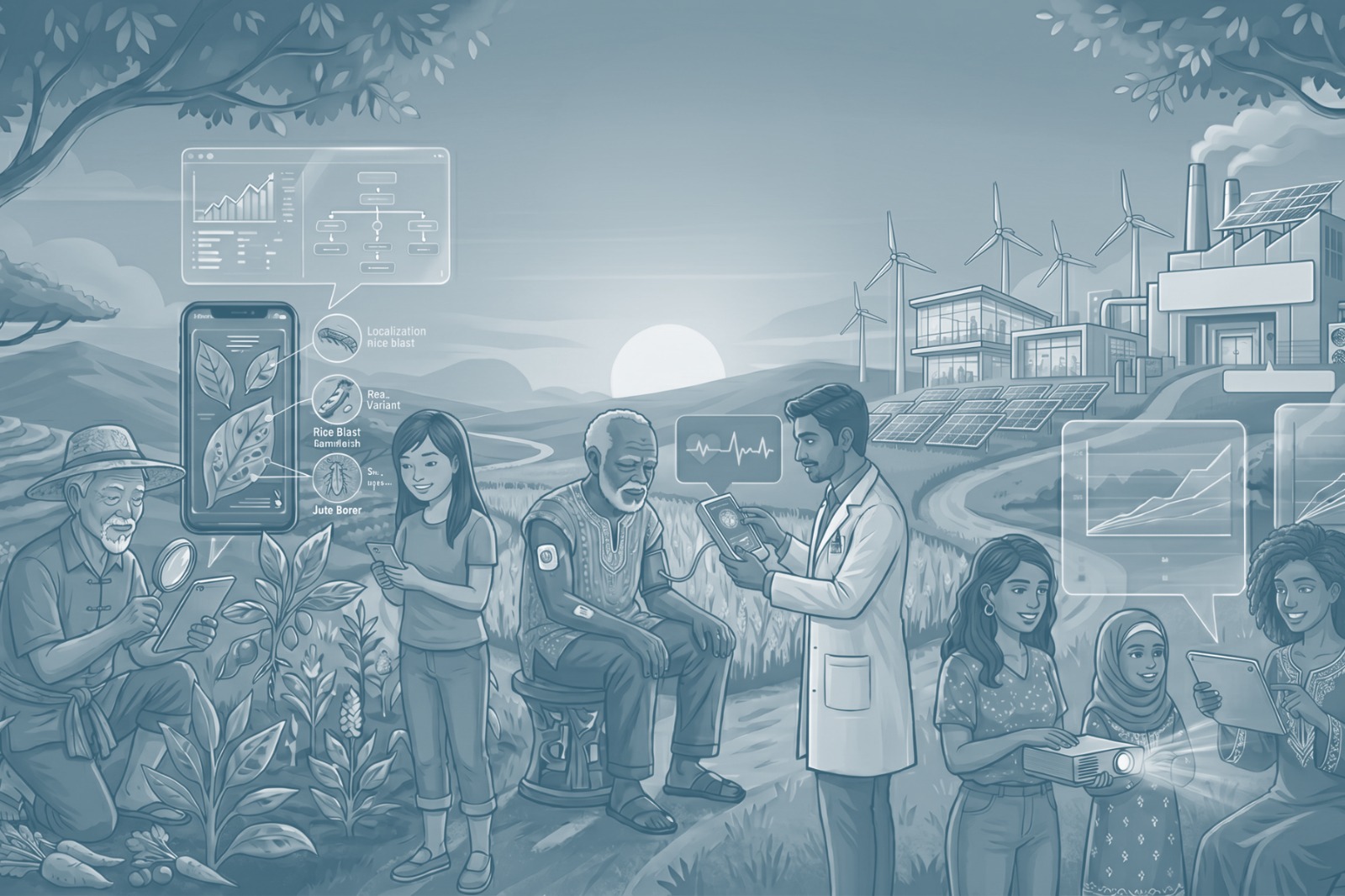
In the last episode of The Myth of Small AI, I talked about how Small AI is much more cost effective than LLMs in specialized situations, especially in the context of LDCs and LMICs. Local solutions with local data built by local innovators on Small AI models may serve farmers, patients and students in far flung corners of the world untouched by mega data centres and undisturbed by large language models.
Specialized Small AI models don’t need to know the history of the Roman Empire, or write Shakespeare. They just need to be highly accurate at solving a specific, localized problem using localized data with localized training.
- Agriculture: In Kenya, the Nuru app allows farmers to photograph a diseased leaf and receive an immediate diagnosis offline. Unlike Big AI, which might hallucinate general plant advice, these SLMs are fine-tuned on local soil data and specific African pest variants. They provide sub-100ms response times on edge hardware, which is critical when a farmer is standing in a field with zero bars of signal.
- Health: In India, Wadhwani AI’s tuberculosis detection tools use cough sound analysis and automated blood test interpretation to identify TB cases, including asymptomatic ones, reaching over 150 million people and saving an estimated 300,000 patient days annually.
- Education: In Ghana, the “Rori” AI math tutor delivered via WhatsApp costs five dollars per student per year and produces learning gains equal to adding an extra teacher. A local teacher can help train an SLM on a regional curriculum much faster than they could navigate the complex guardrails of a massive frontier model.
The accuracy of output in these sectors isn’t about knowing everything. It’s about knowing the right things at the right place delivered in a way that the right people can understand and use.
Gartner recently predicted that by 2027, task-specific models will be used three times more than general-purpose LLMs. For LDCs, this is a godsend. It allows them to bypass the Western-centric bias of Big AI models and Big Data. Instead of a model that thinks corn always looks like the subsidized crops of the American Midwest, Small AI can be trained to recognize the unique agricultural landscape of the Sahel.
The constraints of Big AI in the context of LDCs and LMICs
Big investors pour hundreds of billions of dollars worth investments in Big AI infrastructure. The end product reaches users who can pay $20 a month for a subscription. It is a reasonable amount for most subscribers in the global North and perhaps wealthy subscribers in the global South, but it is also a week’s income for a smallholder farmer in Malawi.
Three structural problems with Big AI explain why Small AI deserves far more attention than it receives.
- The economics does not make sense. Big investors put hundreds of billions into infrastructure designed to serve premium subscribers. The last mile of the underserved world is never the priority. It cannot be based on business logic of big AI investments, That’s why it remains out of reach of the average farmer, students in a remote village or a patient in a rural community clinic.
- Big AI does not know local realities. Data capture is expensive. The result is that Big AI training sets are vast but generic, skewed toward populations that generate data at scale but local data is often overlooked and local contexts remain underrepresented. A model trained without local data cannot provide solutions to local problems.
- Absence of local languages. The majority of the world’s languages remain effectively absent from frontier model training. Exclusion by language leads to exclusion of entire communities.
Then What’s the Problem in Adopting Small AI?
Small AI makes a lot of sense for developing countries and marginalized communities of developed countries, however, it also begs the question of whether there’s human capacity to build small AI, particularly in developing countries. Most LDCs and LMICs need to have the depth in human capacity to build and run Small AI.
The technology is within reach. But is the capability to build and sustain it there yet?Part 3 will seek to answer this question. Stay tuned for the next installment!
Anir Chowdhury
#SmallAI #DigitalInclusion #DPI #GlobalSouth #AI4Development #SpringMeetings2026
Leave a Reply